Gender Predictor Using Due Date: Does It Actually Work?
Few things spark more curiosity during pregnancy than trying to guess whether you're having a boy or a girl. One of the most popular approaches floating around online and in parenting forums is the idea of a gender predictor using due date as the key input. But how much truth is actually behind these methods? If you're an expectant parent looking for answers, here's a clear, honest look at what works, what doesn't, and how to separate fun from fact.

What Is a Gender Predictor Using Due Date?
A gender predictor using due date is any method that claims to estimate your baby's sex based on the date your baby is due — or your last menstrual period. The idea is that certain patterns in dates, when run through a formula or chart, can reveal whether you're carrying a boy or a girl. These methods range from ancient Chinese calendars to simple mathematical formulas passed down through generations.
The appeal is obvious: it's free, it requires no medical equipment, and it gives you an answer — even if that answer isn't guaranteed. But before you start decorating the nursery blue or pink based on a due date calculation, it helps to understand where these methods come from and whether they have any scientific merit.
Popular Methods That Use Due Date to Predict Gender
The Mayan Calendar Method
One of the oldest gender predictor using due date tools is the Mayan gender predictor. This method looks at the year of conception and the mother's age at conception. If both numbers are even or both are odd, the tradition says you're having a girl. If one is even and one is odd, it predicts a boy. The theory taps into the Mayan belief that balance signals one outcome and imbalance signals another.
The Chinese Gender Predictor Chart
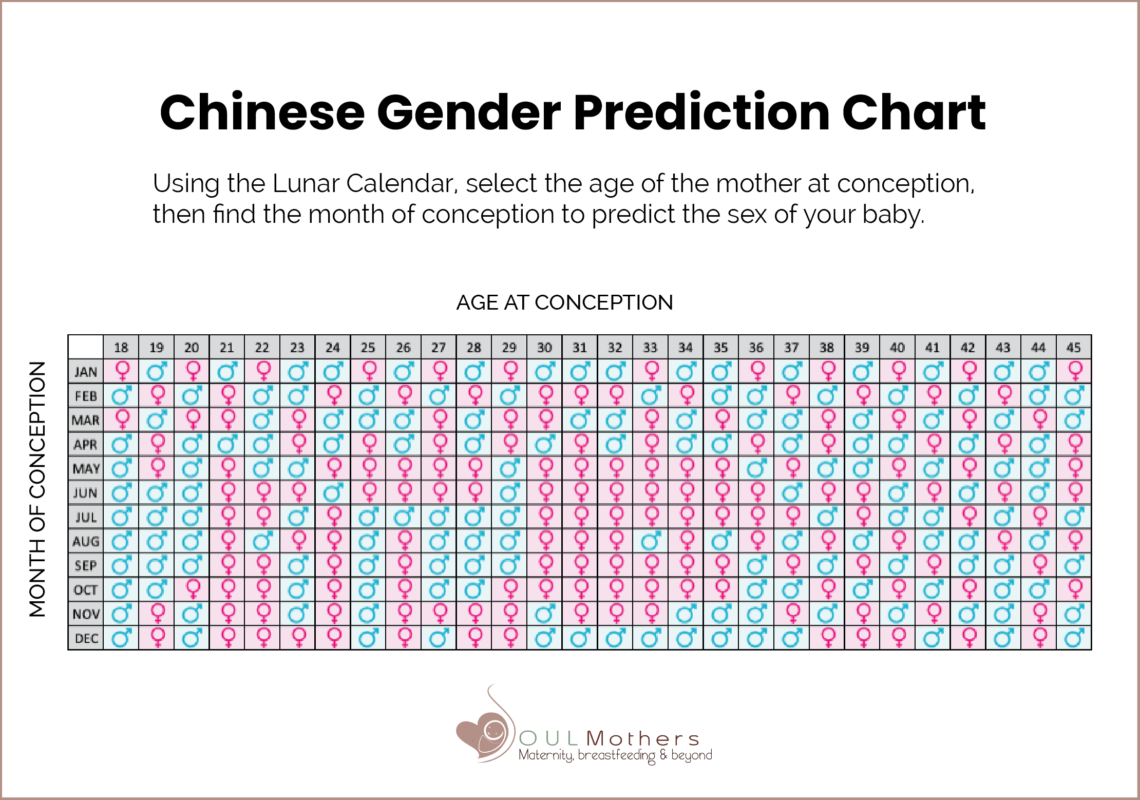
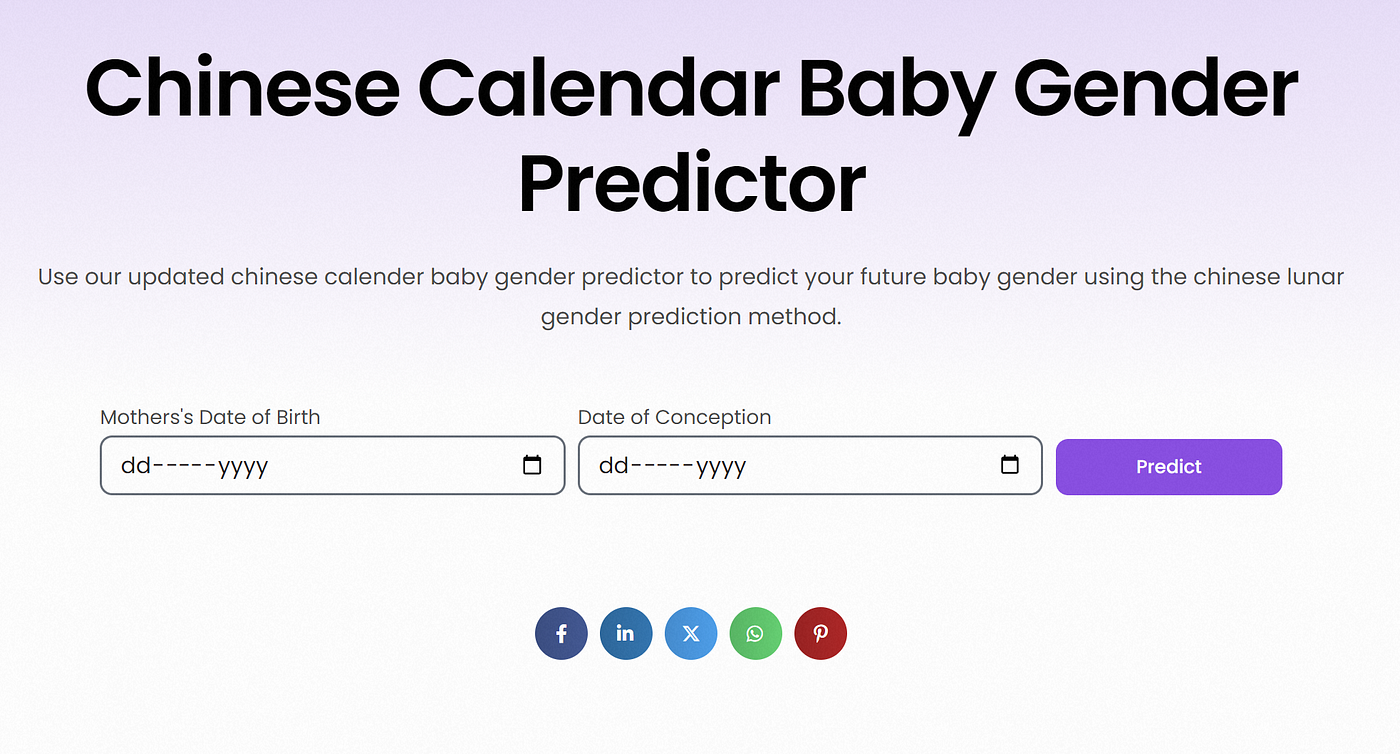
The Chinese gender predictor is perhaps the most famous due date-based method. Originating from a chart discovered in a 13th-century royal tomb, it claims to predict baby gender based on the mother's lunar age at conception and the lunar month of conception. Users simply plug their numbers into a chart or calculator and read the result. Some claim this chart has an accuracy rate as high as 90%, though no peer-reviewed study has confirmed these numbers.
The Ramzi Theory
Dr. Saad Ramzi Ismail proposed that the placement of the placenta — relative to the uterus — as seen in early ultrasound can indicate fetal sex. While this method technically uses ultrasound imaging rather than a calendar, many online calculators incorporate it alongside due date inputs to generate predictions. It's gained significant traction in online pregnancy communities, but mainstream obstetrics does not recognize it as reliable.
The 7-7 Rule and Other Mathematical Formulas
Some gender predictor using due date formulas are refreshingly simple. The so-called 7-7 rule involves adding 7 to the mother's age and the conception month to estimate gender. Others use combinations of the month of conception, the mother's birth month, and the due date month to produce a result. These methods are largely for entertainment, but they persist because they require no special tools — just a calendar and a few minutes.
What Science Actually Says About Due Date Gender Prediction
Here's the honest answer: no gender predictor using due date method has been scientifically validated as accurate. Baby sex is determined at the moment of conception when an X or Y chromosome from the sperm joins with the X chromosome from the egg. XX produces a girl; XY produces a boy. This process is random and isn't influenced by calendar dates.

That said, some correlation studies have looked at whether certain patterns emerge across large populations. A 2008 study published in Vector-Borne and Zoonotic Diseases noted that seasonal conceptions appeared to correlate slightly with offspring sex ratios, possibly due to environmental factors. However, this effect is small and certainly doesn't apply to individual predictions. At best, these are population-level trends, not reliable tools for any single pregnancy.
The most commonly cited statistic for old wives' tale methods is roughly 50% accuracy — which is exactly what you'd expect from random guessing. When something claims to predict gender better than chance, you should ask for peer-reviewed evidence before trusting it.
Reliable Ways to Determine Baby's Gender
If you're looking for answers you can actually count on, here are the medically accepted methods:
- Ultrasound (mid-pregnancy): The anatomy scan, typically done between 18 and 22 weeks, can usually identify genital anatomy with high accuracy — often above 95%.
- Cell-Free DNA Testing (NIPT): This blood test analyzes fetal DNA in the mother's bloodstream and can determine sex chromosomes as early as 10 weeks with accuracy above 99%.
- Chorionic Villus Sampling (CVS): A diagnostic test usually done around 10-13 weeks that examines placental tissue. It's primarily used to screen for chromosomal conditions but also reveals sex chromosomes.
- Amniocentesis: Typically performed between 15-20 weeks, this test analyzes amniotic fluid and can definitively determine sex. It's usually reserved for high-risk pregnancies due to a small risk of miscarriage.
These are the only methods that give you dependable information. Everything else — including any gender predictor using due date — is, at its core, a guessing game dressed up with historical charm.
Why Do So Many People Believe in These Methods?
Part of the reason gender predictor using due date tools stay popular is a psychological phenomenon called confirmation bias. If someone tells you based on your due date that you're having a girl, and you later find out you're expecting a daughter, that prediction feels powerful. But every time the prediction is wrong, it gets quietly forgotten. Over time, only the "hits" seem to stick in memory.
There's also a social element. Sharing a due date with friends or family and hearing a gender prediction creates conversation, excitement, and a sense of connection during a time when parents-to-be are navigating a lot of unknowns. That's not nothing — even if the method itself has no scientific basis, the joy it creates has real value.
Should You Use a Gender Predictor for Fun?
Absolutely — as long as you treat it as entertainment rather than gospel. Using a gender predictor using due date can be a playful bonding moment with your partner, your mother, or your coworkers. It gives you something to speculate about during the long weeks before your next ultrasound. And if you're planning a gender reveal party, these methods can provide harmless inspiration for a reveal theme.
The key is keeping expectations in check. Treat the result as a conversation starter, not a diagnosis. Decorate the nursery in neutral colors until you know for sure. Save the blue paint and the pink curtains for after your doctor confirms the news.
The Bottom Line
A gender predictor using due date can be a fun way to pass the time during pregnancy, and some methods like the Chinese gender chart have fascinating historical roots. But none of them are scientifically reliable. For accurate answers, count on ultrasound and prenatal testing. For entertainment and speculation, go ahead and try a few — just remember that the only real answer comes from your healthcare provider.
Pregnancy is full of unknowns, and that's part of what makes it special. Enjoy the guessing games while they're still games, and look forward to the moment when ultrasound or DNA testing gives you the answer you've been waiting for.