How to Fill Out DA Form 4856 Step by Step
If you have been handed a blank DA Form 4856 and told to "counsel" someone in your unit, you are not alone. The Developmental Counseling Form is one of the most common, and most misunderstood, pieces of paperwork in the U.S. Army. This guide walks you through how to fill out DA Form 4856 correctly, block by block, so the session supports the soldier instead of creating rework for the NCO.

What DA Form 4856 Is and When to Use It
DA Form 4856 is the Army's standard Developmental Counseling Form, prescribed by AR 600-100 and used across the active Army, Army Reserve, and National Guard. It captures a counseling session between a leader (the counselor) and a soldier, subordinate, or other person receiving guidance. Leaders use it for everything from initial counseling when a soldier arrives at a unit, to event-based counseling after a problem or achievement, to performance counseling during the rating period.
The form itself does not judge performance; it records the conversation. That distinction matters because a poorly completed form can invalidate a later action, such as a flag, an Article 15, or a non-promotable status. Filling it out correctly is less about neat handwriting and more about capturing the substance of the discussion in clear, factual language.
Common Reasons to Initiate a Counseling
- Initial / integration counseling when a soldier joins the unit.
- Quarterly or monthly performance counseling for NCOs and officers.
- Event counseling after a positive event (school completion, award) or negative event (incident, failure).
- Referral counseling that supports a flag or a rehabilitation plan.
- Career counseling tied to promotions, reclassifications, or transitions.
How to Fill Out DA Form 4856: Field-by-Field Instructions
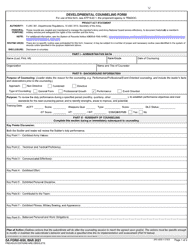
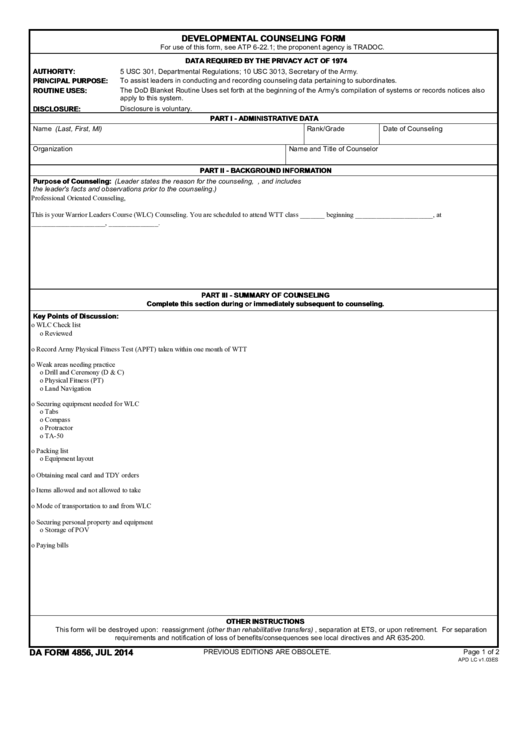
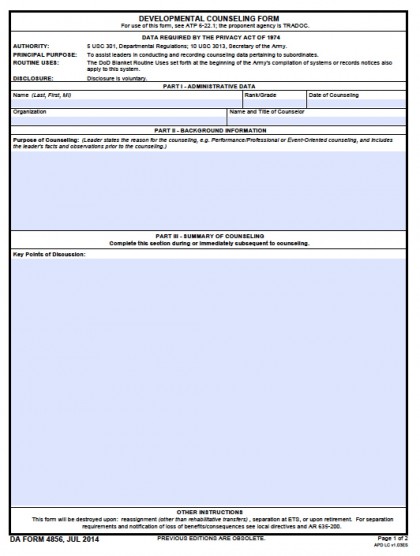
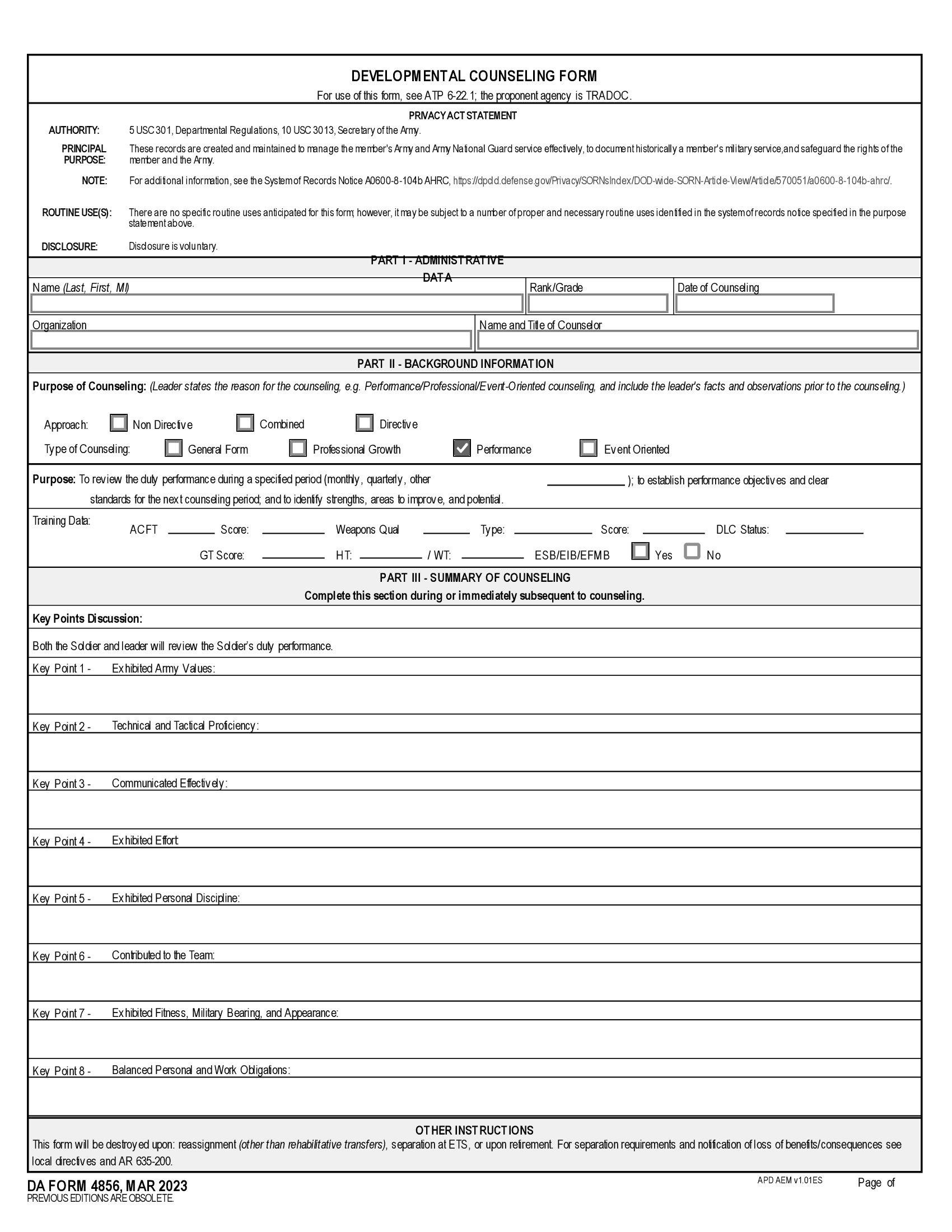
The current version of the form (revised July 2014) has six main data blocks plus a plan of action and leader remarks section. Fill the administrative blocks first; these determine the legal chain of custody for the document.
Top of the Form: Data Blocks 1 Through 4
- Name (Last, First, MI): Full legal name of the soldier or person receiving counseling. Match it to the ID card; avoid nicknames.
- Rank / Grade: Use the standard two-character abbreviation (e.g., SGT, 1LT, SSG).
- Date of Counseling: The actual date the counseling session was held, not the date the form is filed.
- Organization: The unit of assignment at the time of counseling, including company/battery/troop and battalion-level identifiers if applicable.
These four blocks must agree with the soldier's official records. Discrepancies in name, rank, or organization are the most common reasons a legal review will send a counseling back for correction.
Block 5: Name and Rank of Counselor
Enter the counseling leader's name (last, first, MI) and rank. The counselor is typically the rater or senior rater, but it can also be a first-line supervisor, a school instructor, or a mentor assigned by the chain of command. The relationship between counselor and soldier determines who reviews and signs the form, so spell this out clearly.
Block 6: Developmental Counseling Type
DA Form 4856 supports four counseling types. Check exactly one:
- Event-Oriented: Tied to a specific incident or event, positive or negative.
- Performance: Covers duty performance over a defined period.
- Professional Growth: Focuses on career goals, training, and developmental milestones.
- Initial / Integration: Covers rights, responsibilities, and expectations when a soldier joins a unit or organization.
Picking the wrong type confuses later readers. If you are discussing both performance and a single event, choose the dominant theme of the conversation; you can reference the other in the narrative.
Title Block and Purpose Statement
Under the title block, write a brief statement of the purpose of the counseling. Two to four sentences are enough. State the issue, the trigger (date of an event, arrival in the unit, upcoming board), and the desired outcome of the session. The purpose statement frames everything below it, so make it concrete.
Example purpose statement for an event-oriented counseling:
"You were counseled today regarding the missed PT formation on 14 March 2024. The purpose of this session is to review the expectations for morning accountability, identify the cause of the missed formation, and outline corrective actions to prevent recurrence."
Key Points of Discussion

This is the substance of the form. Use short paragraphs and direct language. Capture what the soldier said, what the counselor observed, and what standards apply. Cite the specific regulation or standard (AR 350-1 for APFT, AR 670-1 for uniform, AR 600-100 for the counseling process itself) whenever the standard is the foundation of the discussion.
Avoid vague phrases such as "failed to meet standards." Replace them with measurable language: "failed to meet the APFT 2-mile standard by 1:24," "missed formation three times in 30 days," "wore unauthorized earrings in the duty uniform."
Plan of Action (What the Soldier Will Do)
List concrete actions the soldier agrees to take. Each action should be specific, measurable, and time-bound. For example:
- Complete a structured APPT prep plan, documented in the weekly training schedule, until the next APFT on 15 June 2024.
- Sign in with the duty NCO each morning by 0645 for the next 30 days.
- Remove unauthorized jewelry and replace it with the prescribed items prior to next duty day.
Vague commitments such as "try harder" or "be more professional" are not a plan. If the soldier struggles to identify actions, coach them; the plan is theirs, not yours.
Closing the Counseling: Signatures
Both the soldier and the counselor sign and date the form after the discussion. The signature block includes a line indicating whether the soldier wants to submit comments in writing within a defined period (commonly 7 days). Add a line for the senior rater's review if the senior rater is not the counselor.
If the soldier refuses to sign, do not coerce them. Annotate the form with the date, time, and the reason given, then have a witness sign. The refusal does not invalidate the counseling; it documents that the leader attempted the session.
Leader Responsibilities and Follow-Up
A DA Form 4856 is only useful if the leader follows up. Schedule the next counseling at the end of the session, write it into the leader calendar, and reference the plan of action at that next meeting. If the soldier does not meet the plan, that is the foundation for the next event counseling, not a surprise.
Common Mistakes to Avoid When Filling Out DA Form 4856
- Skipping the chain of command. Counseling is part of command climate, not a private tool. Senior raters should know about patterns.
- Using emotional or judgmental language. Stick to observable facts and standards. "You are lazy" is not counseling; "you arrived 25 minutes late on four occasions" is.
- Failing to date everything. Every signature, annotation, and initial needs a date.
- Letting the form become a punishment. Counseling is a development tool. Reserve punitive tools for punitive situations.
- Storing copies outside policy. Privacy Act information requires secure storage in the soldier's counseling jacket, not an unsecured email inbox.
Tips That Make the Form Faster and Cleaner
Most leaders fill out dozens of these forms each year. A few habits keep the work efficient and accurate:
- Use the fillable PDF or the ACE form builder. The digital version auto-populates standard blocks and reduces typos. The current PDF can be downloaded from the Army Publishing Directorate.
- Keep a template folder. Save a starter copy for each counseling type with the boilerplate language, then customize the narrative and plan.
- Counsel within 7 days of an event. Memory fades fast, and the regulation expects timely action.
- Read the form back to the soldier. A short read-back catches wording problems before the signature.
- File a copy in the soldier's counseling jacket and brief the senior rater. A counseling form only matters if the chain reads it.
What to Do After the Counseling
File the signed form in the soldier's counseling file, document the plan in the next synchronization meeting, and revisit it at the next scheduled counseling. If the issue repeats, the next DA Form 4856 should explicitly reference the prior one: "This is a follow-up to the developmental counseling dated 14 March 2024." That continuity turns isolated paperwork into a record the chain of command can actually use when the soldier's performance has to be summarized at a board, a removal event, or a promotion review.
Filling out DA Form 4856 correctly is less about memorizing blocks and more about respecting what the form represents: a documented conversation between a leader and a soldier, anchored in standards, with a path forward that both parties agree to follow.